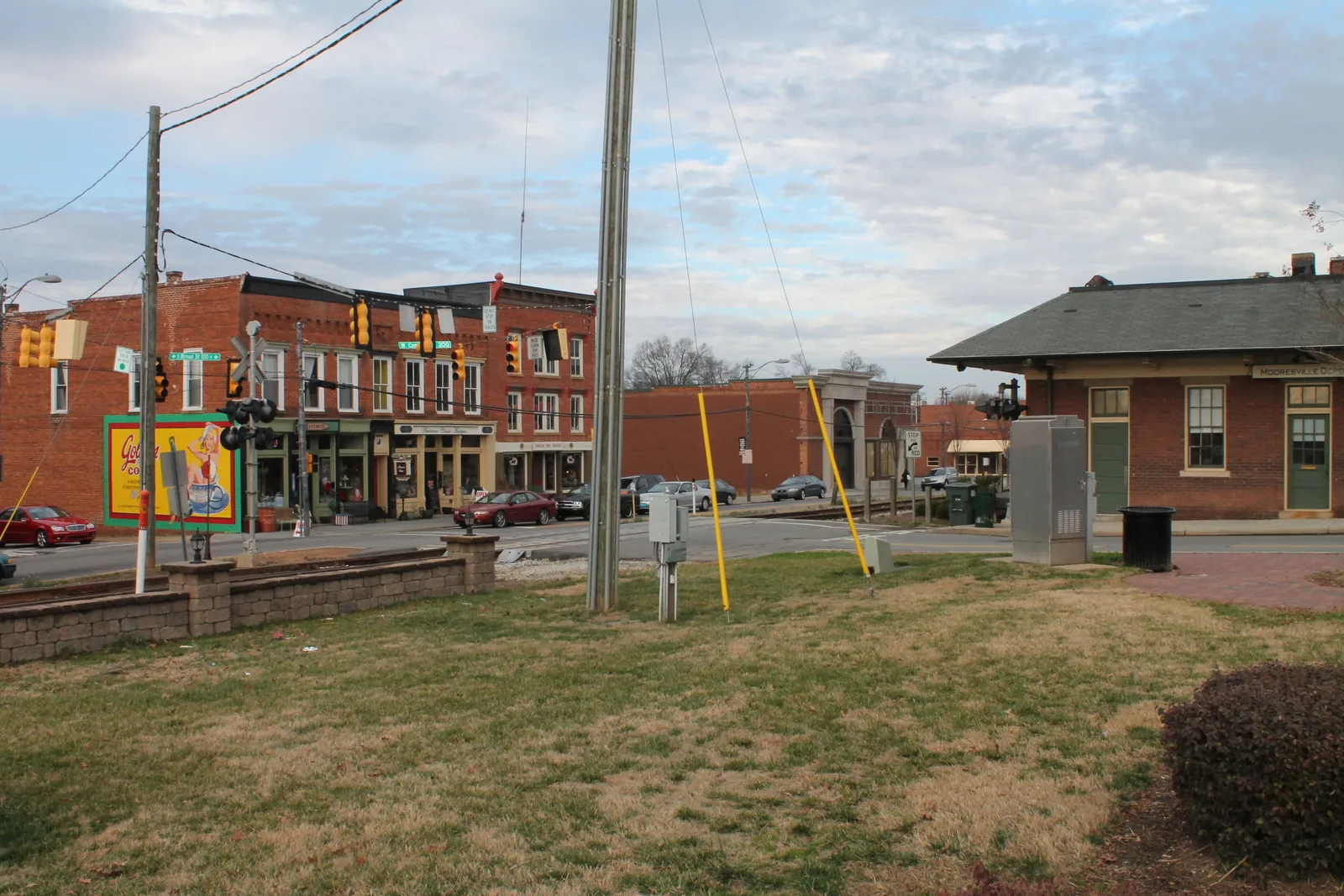
Mooresville grew from Moore's Siding on the railroad and was incorporated in 1873. Its downtown, mill village and seven other sites are on the National Register.
Last checked Oct. 11, 2026. History on this page comes from the Town of Mooresville’s Our History page and the N.C. State Historic Preservation Office’s Mooresville Architectural Survey final report (2016). Listing dates come from the National Park Service’s National Register records.
Mooresville began as a railroad stop. The town was incorporated in 1873 along the Atlantic, Tennessee and Ohio Railroad, and it grew into a cotton-mill town and, much later, “Race City, USA.” Its downtown around the old depot is a National Register historic district. For local history, the town sends visitors to the Mooresville Museum, 132 E. Center Ave.; for preservation rules, call Planning at 704-662-7040.
Visit
- Mooresville Museum: 132 E. Center Ave.; see themooresvillemuseum.org for hours
- Historic districts: walk Main and Broad streets downtown and the Mill Village south of downtown
- Preservation questions: Planning and Community Development, 704-662-7040
Timeline
From the State Historic Preservation Office’s 2016 survey report unless noted:
- 1861: the AT&O Railroad between Charlotte and Statesville is built, on the eve of the Civil War, and rebuilt after it.
- Before the Civil War: landowner John Franklin Moore donates land for the depot and a cotton loading platform at the stop then known as Moore’s Siding. He also gives land for Presbyterian and Methodist churches and for Mooresville Academy, on what became Academy Street.
- 1873: the community is incorporated as the Town of Mooresville, with limits reaching a mile around the depot.
- 1874: the two-story frame Mooresville Academy, now gone, is built on Academy Street, which takes its name.
- 1894: Mooresville Cotton Mills starts operating with 5,000 spindles and becomes the town’s largest employer. The same year, Southern Railway takes over the line.
- 1899: the D.E. Turner & Co. hardware store opens; the town says its interior is unchanged, and that it may have had the town’s first gasoline pump.
- Late 1910s: the brick railroad station that still stands replaces the frame depot.
- 1924: a fire destroys the wooden Mooresville Flour Mill on North Main Street; it is rebuilt in brick, and in 1928 businessmen led by Espy Watts Brawley incorporate it as Mooresville Flour Mill.
- December 1939: the Mooresville Public Library opens on South Main Street, a gift from Lutell Sherrill Williams, built on the footprint of her family home, the town says.
National Register of Historic Places
Listings in and near Mooresville, with the date each was added, from the National Park Service’s records:
| Listing | Address | Listed |
|---|---|---|
| Johnson-Neel House | Near Mooresville | June 20, 1975 |
| Mooresville Historic District | Downtown, along N.C. 115 and N.C. 152 | Nov. 24, 1980; enlarged April 23, 2020 |
| South Broad Street Row | 251-311 S. Broad St. | Nov. 24, 1980 |
| Espy Watts Brawley House | 601 William St. | Nov. 24, 1980 |
| Cornelius House | Near Mooresville | Nov. 24, 1980 |
| Mooresville Mill Village Historic District | South of downtown, around Wilson, Catawba and Kennette avenues | April 24, 2012 |
| Reid Memorial Presbyterian Church | 336 N. Broad St. | April 23, 2020 |
| Watkins Chapel AME Zion Church | 505 Cascade St. | April 13, 2022 |
| Mooresville Water Pump and Filter Plant | 422 W. Moore Ave. | April 18, 2023 |
Most are private property; view them from the street.
The historic districts
- Mooresville Historic District covers the old commercial center by the depot along Main and Broad streets and nearby residential blocks. It was listed in 1980 and enlarged in 2020.
- Mooresville Mill Village Historic District, listed in 2012, covers about 160 acres and hundreds of one-story and story-and-a-half frame mill houses.
Work in the town’s historic district follows its Historic Preservation Standards; see our building permits and zoning guide.
What this means for you
- Start a downtown walk at the depot on Broad Street and head up Main Street.
- Own a building in the historic district? Talk to Planning before you start work.
More: getting around Mooresville and Mooresville population.
Frequently asked questions
When was Mooresville founded?
Mooresville was incorporated as a town in 1873, with town limits reaching a mile around the railroad depot. Before that the small market stop was known as Moore’s Siding.
Who is Mooresville named after?
John Franklin Moore, a landowner whose property covered much of the town. He donated land for the railroad depot, two churches and Mooresville Academy.
What is on the National Register of Historic Places in Mooresville?
The Mooresville Historic District and South Broad Street Row (both 1980), the Mooresville Mill Village Historic District (2012), Reid Memorial Presbyterian Church (2020), Watkins Chapel AME Zion Church (2022) and the Mooresville Water Pump and Filter Plant (2023), among others.
Is there a history museum in Mooresville?
Yes. The Mooresville Museum is at 132 E. Center Ave. downtown. The town points visitors interested in local history there; check its website for hours.
Have your say